Uncategorized
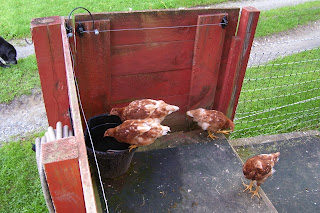
This photo is just before I put the chickens in for the night. A bit blurry but as you can see the chickens have grown fond of the sheep!

The following night when I came down to lock the chickens in it was out of control. They were starting to roost and were all over the barn, high up on beams and posts. Realizing they were running the barn now, I took steps to secure their temporary quarters the following morning. One hen managed to escape the following two nights until I found her escape route. Now they are trained to go in to their coop at dark where they are secure for the overnight.
Uncategorized
The chickens are soooo happy to have Della and Lucy to share the barn with. The hens follow them all around the field while they graze, grabbing crickets and all sorts of other bugs. Last evening when I went down to put the chickens in for the evening, they were all over the place. Two were on Lucy’s back, one way atop the shearer’s post (8′ plus) others roosting on the rails around the lambing jugs. It was a laugh!

The hen’s love the sheep, but do the sheep love the hens? We’ll never really know will we?!
Uncategorized
Jack and I gathered the flock for their mid-summer night’s dream (not). Today was de-worming and hoof trimming Wednesday. The weather has been terribly wet this summer. In the month of July I wonder if we had ONE dry day. So far in August forget it. It is grating on everyone…sun peaks out for an hour and then torrential downpours. Below Bea gives her nod of approval to the next sheep in line. Bea chose first in line which I think is always wise. First in, first out.
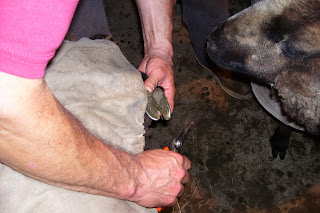
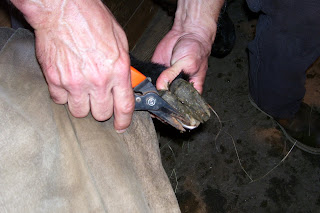
For the flock this means extra vigilance regarding hoof care. When the fields are wet their hooves don’t get a chance to dry out. If the hooves aren’t trimmed regularly the dirt and moisture build up in the untrimmed hoof area causing a multitude of sins. We typically trim 3 times a year; May, August and November. Over the winter our barn and loafing lot offer lots of hard standing surfaces for the sheep. They naturally paw the ground and thereby “trim” their own hooves quite nicely. During the summer months on grass is when the problems tend to occur. These pictures give you an idea of the process. Jack has become very proficient at this. The last picture shows a nicely trimmed hoof.
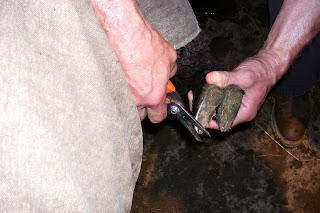
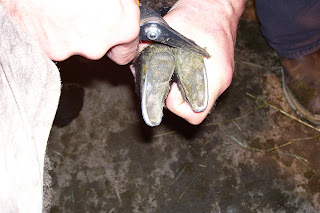
Tonight: 16 sheep times 4 hooves,64 trims. We started at 6:30PM and finished up at 8PM. We have to confine them in order to be efficient. We usually do the trimming in the big barn but because Della and Lucy are still set up in that barn we trimmed in the winter barn. Oh my God, it was steamy, sheepy and yup, shitty. No pictures of us….but we got them all cleaned up and sent them out to a fresh pasture and they were delighted!
So are we, knowing they are foot fancy and comfortable.
Uncategorized
My work in progress this week has been to work with Della and Lucy to gain their trust. They came here, as all the other adult sheep have, fearful and unaccustomed to day to day human touch. I just find it 100% easier to work with sheep when they trust me. It saves stress on them and makes working with them a pleasure. So twice a day, before I let Della and Lucy out in the morning and after dark when I put them in the barn, I take them down the alley where I can close them in a small area. Here they go…
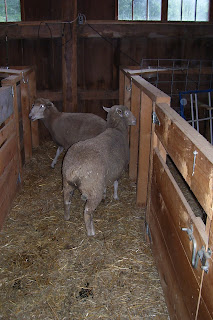
Once there I get down on their level and rub them all over, I hold their chin in my hand and speak soft words, over and over again. I do that for about 5 minutes and then I let them out into the main barn area again. I then hand feed them a few pellets of grain. That has taken some doing also as a week ago there was NO way they’d even come to me. But now they know my hand is good. It has treats and a kind touch. It is working. Now shy Della, who is 5, walks over to me, still cautious, but takes the grain. As I clean their area each day they are getting more used to me coming and going ,the tools, the bucket, all of it. It is gratifying.
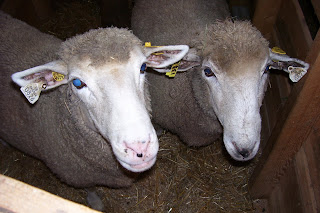
Here they are yesterday, just musing on their new world. Della on the left, Lucy on the right.
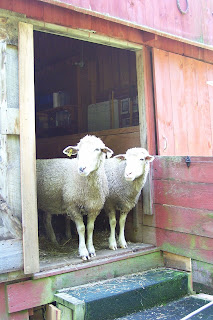
And off they went to do what sheep do best!

Uncategorized
In response to Laurel’s questions in the prior post, I found this explanation for our pretty hens….we have the red sex-links. They are GREAT layers and very calm in the barnyard.
And Laurel, I will be most happy to provide one or more pictures for you….no begging allowed! I’ll be in touch!
Sex-Links are chickens which can be sexed at hatching, usually by color but sometimes by feather development. They are planned crosses, which are hardier and more productive than their parents’ respective breeds. (Ed. note: Be aware that these are breed hybrids and will not breed true.)
(Ed. note: If you came to this page by some name that is not mentioned herein, it’s because I can’t keep up with all the commercial names that sex-linked chickens are marketed under, but I try to link the names to this page when I come across them.)
Both Red and Black Sex-Links use a red male for the father. Either a Rhode Island Red or a New Hampshire may be used.
Black Sex-Links are produced using a Barred Rock as the mother. Both sexes hatch out black, but the males have a white dot on their heads. Pullets feather out black with some red in neck feathers. Males feather out with the Barred Rock pattern along with a few red feathers. Black Sex-Links are often referred to as Rock Reds.
Red Sex-Links are the result of various crosses. White Rocks with the silver factor (the dominant white gene would produce all white offspring) are crossed with a New Hampshire male to produce the Golden Comet. Silver Laced Wyandotte crossed with New Hampshire gives the Cinnamon Queen. Two other crosses are obtained with Rhode Island White x Rhode Island Red, and Delaware x Production Red. These two crosses are simply called Red Sex-Links. Males hatch out white and, depending on the cross, feather out to pure white or with some black feathering. Females hatch out buff or red also depending on cross, and they feather out in one of three ways.
Buff with white or tinted undercolor (such as Golden Comet, Rhode Island Red x Rhode Island White)
Red with White or tinted undercolor (Cinnamon Queen)
Red with Red undercolor (Delaware x Production Red) (In this color pattern it is almost impossible to distinguish daughters’ color from father’s color.)